 2026-08-21
If your sliding door is hard to open, start with the track—not a replacement quote. Vacuum loose debris, wipe the track with a mild nonabrasive cleaner, and test the door again. If it still drags, grinds, sits crooked, or will not latch, the likely causes are worn rollers, poor roller adjustment, a damaged track, or frame movement. Those problems often need a trained technician. Replacement makes more sense when the frame is distorted, the glass or safety labeling is questionable, the insulating glass has failed, or repairs no longer restore smooth, secure operation.
This guide is for U.S. homeowners and project teams deciding what to check, repair, or specify next. It does not replace a hands-on structural, glazing, water-intrusion, or code assessment.
Key Takeaways
- Clean and dry the track before changing adjustments or buying parts.
- A door that moves smoothly but will not latch usually has an alignment or lock problem, not necessarily a failed door.
- Stop using the door if glass is loose, the panel can leave the track, or the frame is visibly separating.
- Compare whole-door NFRC ratings, safety glazing, drainage, installation details, and serviceability before replacing the unit.
Why Is a Sliding Door Hard to Open?
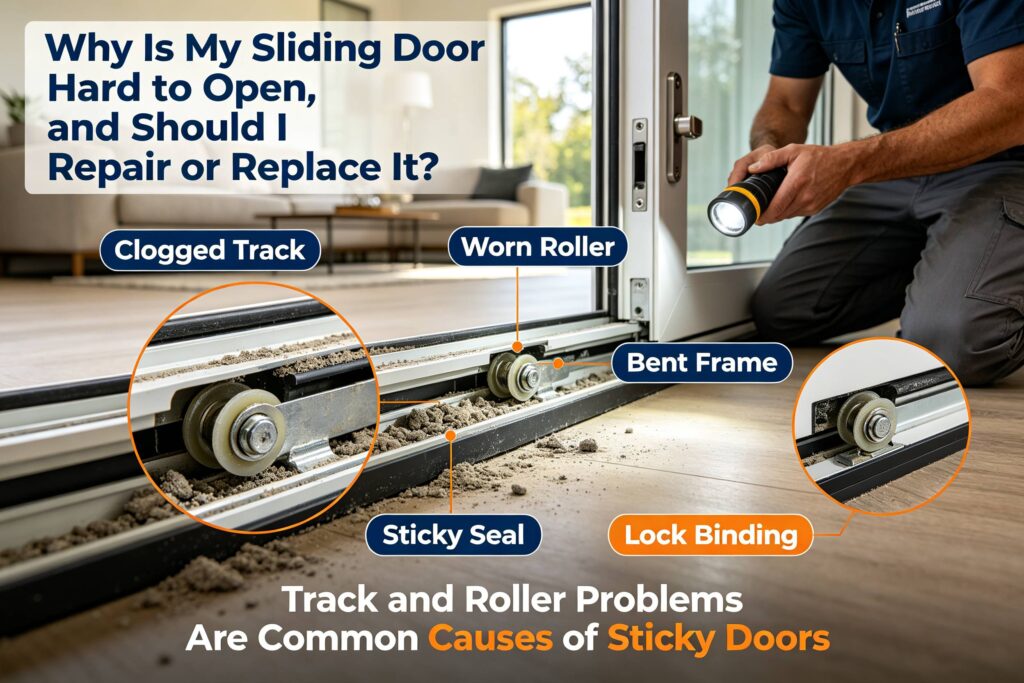
A hard-to-open sliding door is a door whose moving panel encounters abnormal resistance along its normal track. The resistance may come from debris, roller wear, incorrect roller height, a damaged rail, frame distortion, or contact between the panel and another part of the assembly. The sound, location, and timing of the resistance help narrow the cause.
| What you notice | Likely area to inspect | Reasonable next step |
|---|---|---|
| Rough movement along the full travel | Track contamination or worn rollers | Clean the track; arrange roller inspection if roughness remains |
| Resistance at one point | Dented rail, debris, or local frame contact | Mark the location and inspect without forcing the panel |
| Panel looks lower on one side | Roller height or roller failure | Have the adjustment and roller condition checked |
| Door slides but will not lock | Keeper, latch, or panel alignment | Check for visible misalignment; do not grind or enlarge the keeper |
| Drafts or water appear as well | Weather seals, interlock, sill drainage, or installation | Inspect the complete assembly, not just the rollers |
Milgard’s current window and patio-door care guidance recommends periodically vacuuming sliding tracks and notes that roller height can be adjusted on its products. That is useful general evidence, but the adjustment method is product-specific. Use the instructions for your exact brand and series, or hire a qualified service technician when the panel is large or the hardware is unfamiliar.
What Can You Check Safely Before Calling a Technician?
- Clear the opening. Move rugs, furniture, cords, and toys away from both sides. Keep children and pets out of the work area.
- Inspect before moving. Look for cracked glass, a loose glazing bead, a panel that is visibly off the track, bent framing, or a separated corner. If you see any of these, stop.
- Vacuum the track. Use a narrow nozzle to remove grit, hair, leaves, and other loose debris from the accessible sill and track.
- Wipe, rinse, and dry. Use mild soap and water or the cleaner allowed by the manufacturer. Avoid abrasive pads and harsh chemicals that may damage finishes or seals.
- Test gently. Move the panel through its travel without slamming or forcing it. Note where it resists and whether the top and bottom gaps stay even.
- Check the latch. With the door nearly closed, look at how the latch meets the keeper. Do not alter safety or locking hardware to make a misaligned panel appear fixed.
Do not lift a large glazed panel out of its frame by yourself. Panel weight, fragile edges, anti-lift devices, and model-specific removal steps make this different from routine cleaning. If the door can leave the track, wobbles in the opening, or requires excessive force, secure the area and arrange professional service.
Do lubricants solve a sticky door?
Only after dirt and damage have been ruled out. A lubricant placed over grit can create a paste that attracts more debris. Follow the door maker’s care instructions because rollers, track caps, gaskets, finishes, and approved products vary. Milgard’s care guidance, for example, calls for a dry silicone spray on its sliding tracks and rollers, while also warning against petroleum-based chemicals and high-pressure water.
Should You Repair or Replace the Sliding Door?
Repair is usually the better first path when the frame and glass are sound and a serviceable component explains the problem. Replacement is a system decision: it should solve operation, water management, air leakage, safety, energy performance, and installation problems together.
| Condition | Repair is more reasonable when… | Replacement is more reasonable when… |
|---|---|---|
| Track and rollers | Compatible rollers or a track cap are available and the frame is square | The sill or rail is severely damaged, corroded, or no longer supports reliable travel |
| Locking | The latch, keeper, handle, or alignment can be restored with approved parts | The frame cannot hold alignment or the locking system has no safe compatible parts |
| Glass | Glass is intact and correctly retained | Glass is cracked, loose, permanently fogged between panes, or lacks verifiable safety information |
| Air and water | Weather seals and drainage can be serviced and the installation is otherwise sound | Recurring leakage traces to failed frame joints, poor sill design, or installation that requires full removal |
| Project goals | You need restored daily operation with minimal disruption | You also need a different opening size, lower threshold, improved rating, or new panel configuration |
If drafts are the main complaint, first read Forge Windows’ guide to sliding-door air leakage ratings. If the project involves a wide opening, review the nine coordination points in the slim-frame sliding-door specification guide. These help separate a maintenance issue from a design or installation issue.

What Should You Check When Choosing a Replacement?
1. Whole-product energy ratings
Ask for ratings for the exact door size, frame, glass package, and operating configuration. The National Fenestration Rating Council explains that U-factor measures heat transfer, solar heat gain coefficient measures admitted solar heat, and air leakage reports air entering through the product under a defined test. Lower is not automatically better for every value: the right solar heat gain coefficient depends on climate, orientation, and shading.
For residential products, the U.S. Environmental Protection Agency’s ENERGY STAR windows, doors, and skylights guidance uses climate-zone U-factor and solar heat gain coefficient criteria. Treat the label as a verified performance comparison—not as a substitute for correct flashing, perimeter air sealing, and sill drainage.
2. Safety glazing and secure retention
Sliding patio doors contain large areas of glass in a traffic path. The U.S. Consumer Product Safety Commission states that its mandatory architectural-glazing standard applies to patio-type sliding glass doors. Ask the supplier to identify the applicable safety glazing and label for the exact product. The CPSC summary of the standard explains its role in reducing cutting and piercing injuries when glazing breaks.
3. Threshold, drainage, and daily users
Record who uses the door, how often, and whether a mobility device, stroller, or cart must cross it. A low profile may improve passage but must still manage exterior water. Coordinate interior flooring, exterior slope, sill pan or flashing, weep paths, overhangs, and local exposure as one detail. Do not select the threshold from a showroom sample alone.
4. Repair access and parts
Ask how rollers, locks, handles, weather seals, track caps, and insulated glass are replaced. Confirm who stocks parts and whether the moving panel can be removed without damaging adjacent finishes. A slightly wider frame with documented service access may be a better long-term choice than a thinner system with unavailable components.
5. Installation and handoff
Your quote should identify rough-opening preparation, structural review, sill support, flashing, perimeter air and water sealing, interior and exterior finishes, disposal, adjustment, cleaning, and final operating tests. Photograph labels and keep the approved drawings, glass specification, hardware schedule, warranty, and installer contact information.
Still choosing an operating style? Forge Windows’ folding door vs. sliding door comparison explains how clear opening, panel parking, thresholds, and maintenance differ.
Frequently Asked Questions
Why did my sliding door suddenly become hard to open?
A sudden change often points to debris, a damaged roller, an object in the track, or a panel that shifted out of alignment. Stop forcing the door. Inspect the glass and frame, vacuum the track, and test gently. If the panel sits crooked, grinds, or can leave the track, arrange service.
Can I adjust sliding-door rollers myself?
Some products provide accessible roller-height screws, but the correct direction, support method, and target clearance vary. Use instructions for the exact manufacturer and series. Large glazed panels should not be lifted or removed without the right equipment and assistance.
Does a sticky sliding door mean the frame has failed?
No. Dirt, roller wear, and minor misalignment are common repairable causes. Frame failure becomes more likely when gaps change across the opening, corners separate, the track is permanently distorted, locks repeatedly lose alignment, or water damage affects the rough opening.
Is a new sliding door automatically more energy efficient?
No. Compare certified whole-product U-factor, solar heat gain coefficient, air leakage, frame, glass, seals, and installation. A well-rated product can still underperform if the sill, flashing, perimeter air seal, or drainage is poorly executed.
Make the Decision From Evidence, Not Frustration
A difficult sliding door does not automatically need replacement. Start with safe cleaning and observation, then repair serviceable components when the frame and glazing are sound. Replace the system when damage, safety, leakage, unavailable parts, or new project goals justify a complete solution.
If you are planning a custom replacement, send Forge Windows the opening dimensions, photos of the sill and head, panel configuration, climate location, performance targets, threshold needs, and any known damage. That information makes it easier to evaluate a suitable sliding door without promising that a new unit alone will correct hidden structural or installation conditions.