
 2026-08-21
To clean a casement window safely from inside, keep both feet on the floor, remove the interior screen, open the sash only as far as the manufacturer’s instructions allow, and clean only surfaces you can reach without leaning through the opening. Use a soft microfiber cloth, mild nonabrasive cleaner, and a towel on the sill. Do not detach hinge arms, remove a heavy sash, stand on the sill, or defeat an opening-control device. If the exterior glass is not safely reachable from the room, use a qualified window cleaner with appropriate access equipment.
This guide is for U.S. homeowners maintaining an intact, operable window. It does not cover sash removal, exterior rope access, glazing replacement, hidden water leaks, or repair of damaged safety hardware.
Key Takeaways
- Check the care guide for the exact brand and series before releasing a screen, wash hinge, or hardware stop.
- Spray cleaner onto the cloth when practical, not into the operator, hinge, weather seals, or wall cavity.
- Never rely on an insect screen to prevent a fall.
- Cleaning is also a good time to record damaged seals, blocked drainage, loose hardware, fogged glass, or unusual resistance.
What Is a Casement Window, and What Should You Check First?
A casement window is a side-hinged window whose sash swings outward or inward, commonly using a crank operator, handle, or stay. Many U.S. residential casements swing outward and have an insect screen on the room side. The hinge geometry, maximum opening, cleaning access, screen releases, and approved care products vary by model.
Before cleaning, identify the manufacturer and product line from the frame label, warranty paperwork, or order documents. Search for the current care guide and any safety notices. Andersen’s window and patio-door care center, for example, separates guidance for glass, casement hardware, and lubrication. That product-specific approach is safer than assuming every crank-out window releases or pivots the same way.
Set up the room
- Choose a calm, dry day. Do not open a large sash in strong wind.
- Move furniture away from the opening and place an absorbent towel on the sill and floor.
- Keep children and pets out of the room while the window is open.
- Inspect the glass, sash corners, hinges, operator arms, handle, lock, and screen before applying pressure.
- Stop if the glass is cracked, the sash is loose, a hinge is separating, or an opening-control device is damaged.
Gather simple, nonabrasive tools
A typical kit includes two clean microfiber cloths, a small bucket, mild dish soap or an approved glass cleaner, a soft brush, a handheld vacuum with a narrow nozzle, clean water, and two towels. Avoid razor blades, abrasive pads, pressure washers, and solvents unless the manufacturer expressly approves a product for the exact finish or glass surface.
Pella’s current window-cleaning guide recommends a vinegar-based solution for its casement and awning interiors and notes that exterior access from inside is available only on select product lines. The important limitation is “select”: verify that your sash and hinge system is designed for that access.

How Do You Clean Casement Window Glass From Inside?
- Unlock the sash without forcing it. If the handle, lock, or crank resists, pause and consult Forge Windows’ casement-window operator and lock troubleshooting guide before continuing.
- Remove the insect screen according to its instructions. Support the screen with both hands, label its room if several look alike, and store it flat in a safe place.
- Open the sash gradually. Keep your body inside. Check that the operator and hinge arms move smoothly and that the wind is not loading the sash.
- Dry-clean first. Vacuum loose dust from the interior sill and frame so grit does not scratch surfaces or turn into muddy residue.
- Clean the room-side glass. Apply solution to a cloth when practical and wipe from top to bottom. Use a second clean cloth to dry the edges.
- Reach the exterior only through an approved access gap. Clean the portion you can reach with shoulders and hips remaining inside. Do not extend your torso through the opening.
- Close and reposition if needed. Some approved cleaning methods use the gap beside a partly opened sash. Work in small sections instead of stretching around the sash.
- Dry the frame and sill. Remove standing water, then check that visible drainage openings remain clear.
- Reinstall the screen and test. Confirm that every screen latch is engaged, then operate and lock the window gently.
If the outside surface cannot be reached while you remain securely inside, stop. A water-fed pole used from ground level or a qualified window-cleaning service is safer than improvising from a roof, ladder, or open upper-story window.
How Should You Clean the Frame, Hardware, and Screen?
Frame and sill
Vacuum grit before wiping. Use mild soap and water on a soft cloth unless the care guide specifies another method. Clean corners and the accessible sill without pushing debris into drainage paths. Rinse with a damp cloth and dry the surface. Do not fill the sill with water to “test” drainage; water testing requires controlled methods and an understanding of the window assembly.
Hinges, operator arms, and locks
Use a soft brush and vacuum around intact hardware. Do not loosen fasteners merely to clean, and do not spray cleaner or lubricant into a sealed operator. If lubrication is required, use only the product and locations named in the manufacturer instructions. Excess lubricant can collect dust or contact finishes and seals.
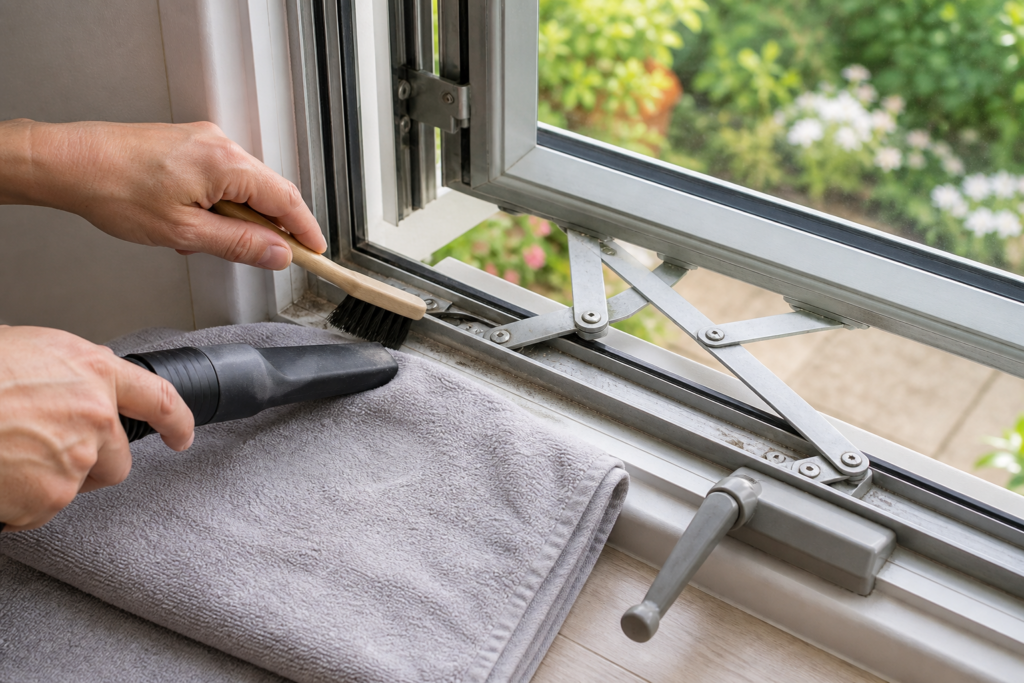
After cleaning, open and close the sash once while watching the hinge arms, operator, and locks. New scraping, uneven gaps, a handle that spins without moving the sash, or a lock that no longer aligns is a service issue—not a reason to apply more force.
Weatherstripping
Wipe weather seals gently with a damp cloth and inspect for cuts, paint, hardening, compression loss, or sections pulled out of the groove. Do not stretch the seal or replace it with a generic foam based only on appearance. The casement-window weatherstrip inspection guide explains how alignment and drainage can mimic a seal problem.
Insect screen
Remove loose dust with a vacuum brush or lint roller, then use mild soap, water, and a soft brush if the screen maker permits washing. Support the frame so it does not rack. Allow it to dry before reinstalling. Review the screen latches and operating clearance described in Forge Windows’ casement-window screen and clearance guide.
When Should You Stop Cleaning and Call a Professional?
| Condition | Why it matters | Next step |
|---|---|---|
| Upper-story exterior glass is beyond safe reach | Leaning through an opening creates a fall risk | Use a qualified cleaner with appropriate access equipment |
| Cracked glass or loose glazing | Cleaning pressure can worsen damage | Keep people away and contact a glazing or window professional |
| Sash drops, twists, or separates from hardware | The assembly may not be securely supported | Stop operation and arrange service |
| Opening-control device is broken or detached | It may no longer limit the opening as intended | Close and lock the window; check the model and current safety notices |
| Moisture or haze is between glass panes | The insulating-glass seal may have failed | Cleaning cannot reach between panes; request product-specific repair options |
| Water stains appear below or beside the frame | The source may be flashing, sealant, drainage, or the wall assembly | Document the pattern and arrange a building-envelope assessment |
Window fall prevention matters during cleaning
The U.S. Consumer Product Safety Commission says screens are intended to keep insects out, not children in, and recommends guards or stops where appropriate. Its window-fall prevention guidance also advises keeping furniture away from windows and using devices that adults can open where emergency escape is required. Do not remove or bypass a safety device for convenience.
Also check model-specific recalls. On February 26, 2026, the CPSC announced a recall of certain window opening control devices sold as kits or installed on Andersen 100 Series casement windows manufactured before November 19, 2025. The CPSC recall notice tells affected consumers to leave the window closed and locked and contact Andersen for repair. This recall is product-specific; use the label details in the notice rather than assuming all casement windows are affected.
Frequently Asked Questions
Can every casement window be cleaned from inside?
No. Exterior access depends on sash size, hinge geometry, opening angle, story, and product design. Some models provide an approved wash position or access gap; others require exterior equipment. Follow the exact care guide and never lean through the opening.
Should I remove the casement sash for cleaning?
Not for routine homeowner cleaning unless the manufacturer provides a specific procedure and you have the required support and assistance. An insulated-glass sash can be heavy, and disconnecting hardware can create fall, breakage, alignment, and warranty risks.
What cleaner is safe for casement-window glass?
Use the cleaner approved by the window and glass manufacturer. Mild soap and water or a nonabrasive glass solution is common, but coatings and finishes vary. Apply to a cloth when practical, test an inconspicuous area, rinse residue, and avoid abrasive tools.
Why is my casement window harder to close after cleaning?
Check for a screen installed incorrectly, a cloth or debris in the sill, displaced weatherstripping, or cleaner residue around hardware. Do not force the crank or lock. If the sash alignment changed or the operator slips, stop and arrange service.
Clean Only What You Can Reach Safely
A clean casement window should not require risky access. Identify the product, prepare the room, use mild nonabrasive tools, keep your body inside, protect the hardware and seals, and stop when the exterior is beyond reach. Use the process to document maintenance issues without turning cleaning into an unplanned repair.
If you are selecting a new casement window, ask Forge Windows about screen removal, cleaning access, opening limits, hardware service, glass options, weather seals, and product-specific care documentation. Those practical details can be evaluated alongside appearance and performance before the order is approved.