 2026-08-14
Direct answer: Drift window glass should be specified by the exact panel size, location, support condition, safety requirement, energy goal, appearance, and verified product documentation. “Drift window” does not identify a standard glass type or U.S. performance class. Buyers must coordinate glass with the frame, tracks, carriers, locks, seals, and panel weight rather than selecting it in isolation. This guide helps U.S. project teams prepare a responsible glass submittal for Forge Windows.
Key Takeaways
- Identify every panel and its location before assigning glass.
- Review federal safety-glazing rules and applicable local codes with qualified professionals.
- Match energy values to the complete documented window configuration.
- Do not substitute glass thickness, tint, or marketing terms for verified performance.
- Approve glass, frame, hardware, labels, and installation responsibilities together.
Why Drift window Glass Cannot Be Chosen Separately
Glass affects panel weight, edge clearances, retention, carrier loads, handle force, and the complete window’s energy characteristics. A larger or differently constructed pane can require different hardware or frame details. The exact relationship depends on the product and panel layout. Request a coordinated schedule rather than adding a generic glass note after the window is selected.
Forge Windows presents the 128 Series Floating Sliding Window and T128 Six-Track Suspended Sliding Window. Use their pages to identify configurations for discussion, not to infer available glass or tested performance. Ask which options apply to the proposed size, track arrangement, panel count, and hardware.
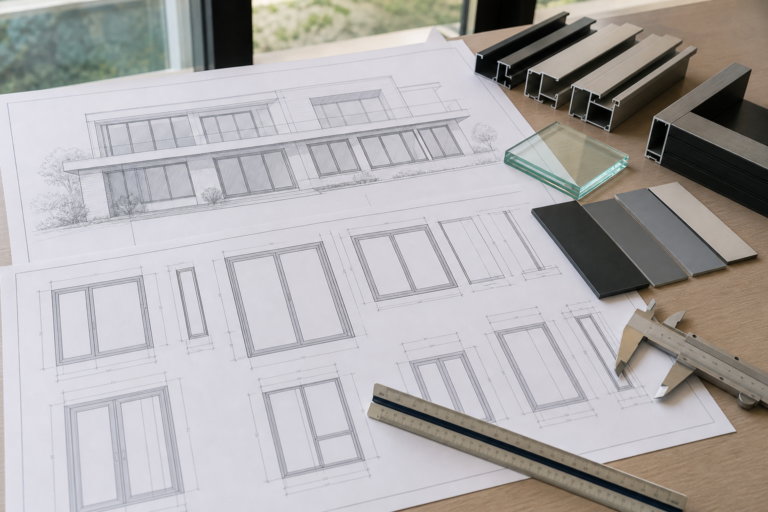
Build a Panel-by-Panel Glass Schedule
| Schedule field | What to identify | Why it matters |
|---|---|---|
| Panel mark | Unique number matching drawings | Prevents glass from being assigned to the wrong panel |
| Panel type | Active, fixed, linked, or service-removable | Connects glass to movement and hardware |
| Location | Room, elevation, level, and nearby hazards | Supports safety and code review |
| Glass make-up | Approved layers, coatings, spacer, and treatment | Defines the actual proposed assembly |
| Documentation | Safety, energy, appearance, and warranty records | Separates verified claims from assumptions |
Coordinate the schedule with the track and panel diagram described in the Forge Windows Drift window configuration guide. Panel numbers should match plans, elevations, sections, and the quotation. Record substitutions and approvals in writing. Do not rely on a verbal description such as “standard tempered glass.”
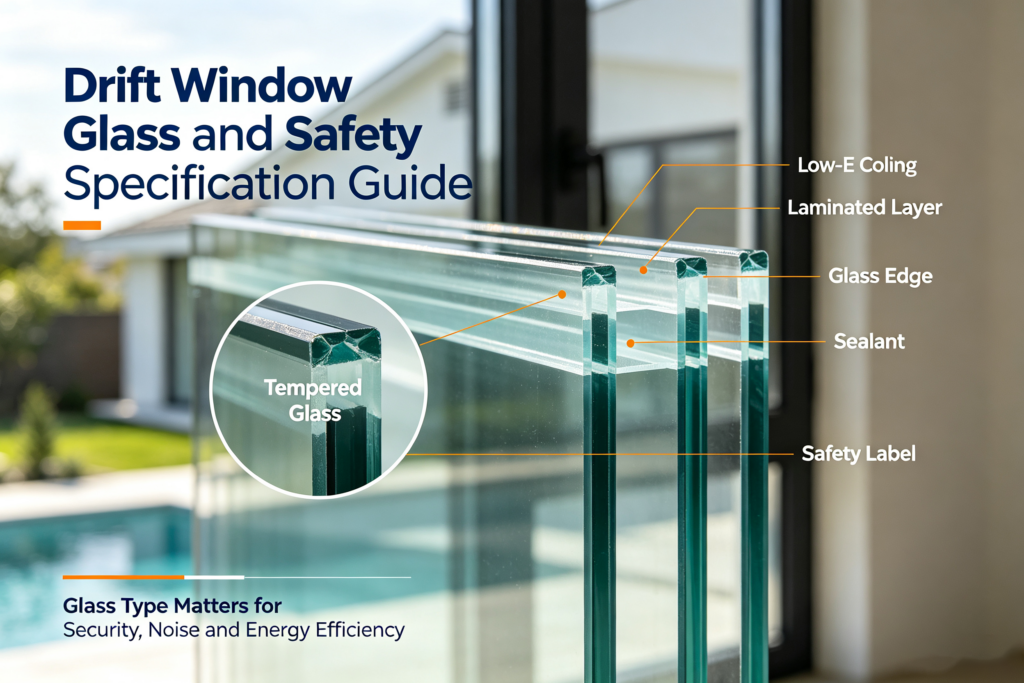
Review Safety Glazing Requirements
Architectural glazing in certain locations can be subject to federal safety requirements. The current text of 16 CFR Part 1201, Safety Standard for Architectural Glazing Materials (accessed August 14, 2026) is an authoritative source. The responsible project team must also review adopted building codes, local amendments, and the exact installation. This article does not determine compliance for a specific opening.
Do not assume that thickness alone proves safety glazing. Request the required marking, certification, or supporting record for the exact glass and application. Keep labels protected through installation and inspection when required. If glass is damaged, incorrectly marked, or different from the approved submittal, stop and obtain professional direction.
Coordinate Glass Weight With Tracks and Hardware
Changing glass construction can change panel weight and the demands placed on rollers, hangers, carriers, stops, locks, and frame attachment. The manufacturer should confirm acceptable combinations for the exact size and configuration. The building structure and installation substrate may also require review. Do not approve a heavier substitution based only on fitting within the glass pocket.
Ask who verifies panel weight, hardware capacity, frame design, anchoring, and field conditions. Include handling and setting procedures in the installation plan. Large or suspended glazed panels require suitable equipment and qualified personnel. Never use the glass edge, handle, or operating hardware as an improvised lifting point.
Verify Whole-Product Energy Information
The National Fenestration Rating Council’s residential guidance (accessed August 14, 2026) explains whole-product U-factor, solar heat gain coefficient, visible transmittance, and air-leakage ratings. Center-of-glass information is not the same as a whole-window rating. Match the proposed frame, operator, size qualifications, and glass configuration to the applicable record.
Use the NFRC Certified Products Directory (accessed August 14, 2026) when verifying listed configurations. Match every result to the manufacturer, series, operator, size qualifications, and glass details. Do not represent a Drift window as certified unless the exact proposed product has current supporting documentation.
Address Appearance Without Inventing Performance
Glass color, reflectance, exterior lighting, interior finishes, sky conditions, and viewing angle can affect appearance. Review representative samples and clarify acceptable variation with the supplier. A small sample cannot reproduce every finished condition. Mockups may help when appearance is a major project requirement.
A darker tint does not automatically establish a particular energy result, and laminated glass does not by itself prove a specific acoustic rating. Request verified data for any numerical claim. Define which surface receives a coating and protect that information through fabrication and installation. Coordinate heat-treated glass expectations with qualified specialists.
Glass Submittal Checklist
- Every panel has a unique mark and location.
- Glass make-up and treatment are fully described.
- Safety-glazing requirements and markings are reviewed.
- Panel weight is coordinated with tracks, carriers, locks, frame, and structure.
- NFRC or ENERGY STAR claims match the exact configuration.
- Appearance samples and acceptance expectations are documented.
- Handling, installation, inspection, cleaning, and warranty responsibilities are assigned.
Send the panel schedule, opening dimensions, project location, glass goals, and required documentation through the Forge Windows contact page. Ask the technical team to identify compatible glass options and missing project inputs. Do not release fabrication until the final coordinated submittal is approved.
Frequently Asked Questions
Does Drift window specify a glass type?
No. The term does not define safety, energy, acoustic, tint, thickness, or construction. Use product- and project-specific documentation.
Is thicker glass always safer?
No. Safety depends on applicable requirements, treatment, construction, testing, marking, and installation. Thickness alone is not proof.
Can the glass be changed after the window is ordered?
A change may affect weight, hardware, frame, ratings, appearance, price, and schedule. Obtain coordinated written approval before substitution.
Does laminated glass guarantee sound reduction?
Do not assume a specific acoustic result without verified data for the complete assembly and test condition. Request documentation for the exact claim.
Where should NFRC information come from?
Use current manufacturer documentation and the NFRC Certified Products Directory, matched carefully to the exact proposed configuration.
Conclusion: Specify Drift window Glass as Part of the System
Drift window glass must be coordinated with panels, tracks, hardware, safety requirements, energy documentation, appearance, handling, and installation. Avoid generic notes and unverified claims. Forge Windows can review available configurations when the project team provides a complete panel schedule and requirements. Approve the exact glass-and-window package before fabrication.