 2026-08-30
Direct answer: Types of casement windows can be identified with five fields: operating control, hinge or handing, sash grouping, relationship to fixed lites, and frame material. Record those fields from the inside-view position before requesting drawings, parts, service, or replacement.
This field-identification guide is for homeowners, surveyors, architects, builders, and service coordinators documenting an existing window. It does not repeat the choice between single, paired, French, push-out, or combined layouts for new design; the existing Forge style guide covers that selection task. Here, the goal is to turn an observed unit into a precise record.
Key Takeaways
- “Casement” identifies side-hinged sash movement, not the frame material, glass package, control method, or number of sashes.
- Use a consistent inside-view convention and photograph the hinge side, lock side, operator zone, meeting condition, and surrounding frame.
- Separate what is directly observed from what still needs a label, drawing, or manufacturer record.
- Do not order parts or a replacement unit from a casual type name alone.
- Assign one opening mark and one five-field identification line to every surveyed window.
What Do “Types of Casement Windows” Mean in a Field Record?
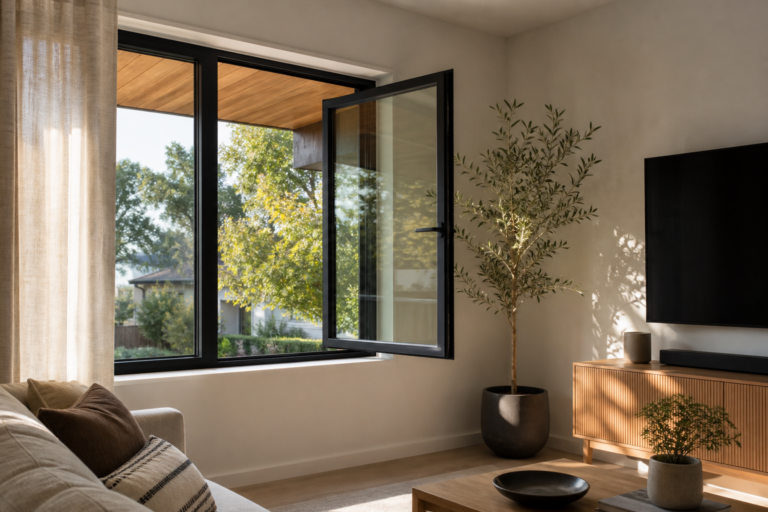
The National Fenestration Rating Council consumer guide defines a casement by side hinges and a sash that swings in or out. Its window-type overview distinguishes casements from vertically sliding, horizontally sliding, awning, fixed, and skylight types. That basic operating definition is the first field check.
A site label such as “left casement,” “French window,” or “vinyl crank window” may mix several classifications. One term can describe hinge location, another the paired-sash arrangement, another the frame material, and another the control. If those terms are copied into a parts request without photographs or drawings, different people may picture different products.
Use the Forge casement styles and layout guide when selecting a new arrangement. Use this identification key when an existing unit must be surveyed, named, and handed off without assuming its product family.
Use a Five-Field Casement Identification Key
| Field | What to observe | How to record it |
|---|---|---|
| 1. Operating control | Crank, folding handle, lever, push-out handle, stay, or unidentified control | Photograph closed and open; do not infer concealed parts |
| 2. Hinge and handing | Hinge jamb and lock jamb from a declared viewing side | “Inside view, hinges left” plus an arrow |
| 3. Sash grouping | Single sash, paired sashes, center member, meeting stiles, or passive leaf | Sketch every moving leaf and opening sequence |
| 4. Fixed-lite relationship | Adjacent, above, below, or within a shared framed assembly | Mark operable and fixed areas separately |
| 5. Frame material | Visible profile, finish, joints, drainage, labels, and known reinforcement | Record “observed” or “unconfirmed”; avoid guessing from color |
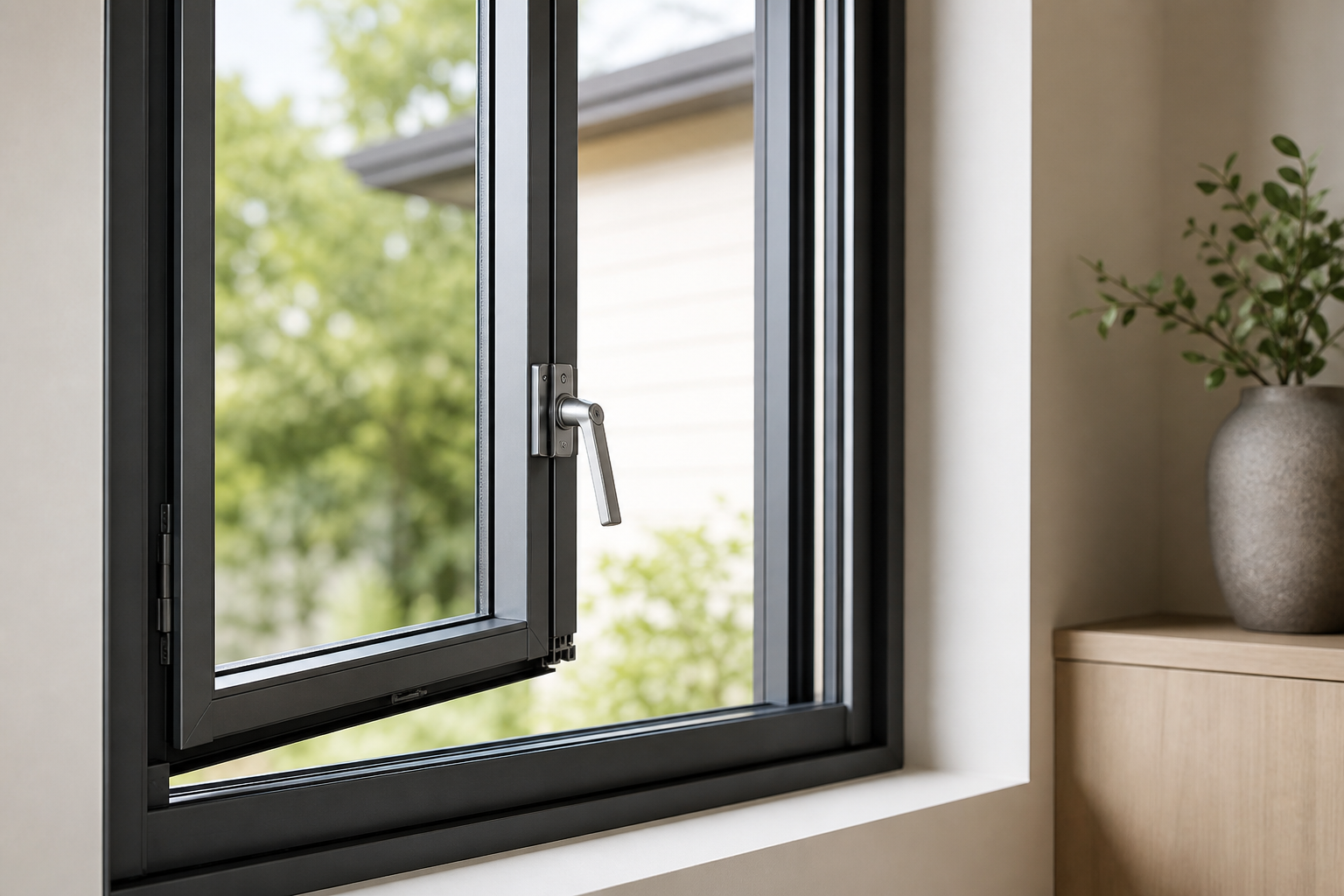
The five fields produce a useful identification line: “W-12, inside view, left-hinged, crank-operated single casement, fixed lite at right, dark finished metal profile, manufacturer/series unconfirmed.” That line is more reproducible than “black casement window.” It also makes the unknowns visible.

Field 1: Operating Control
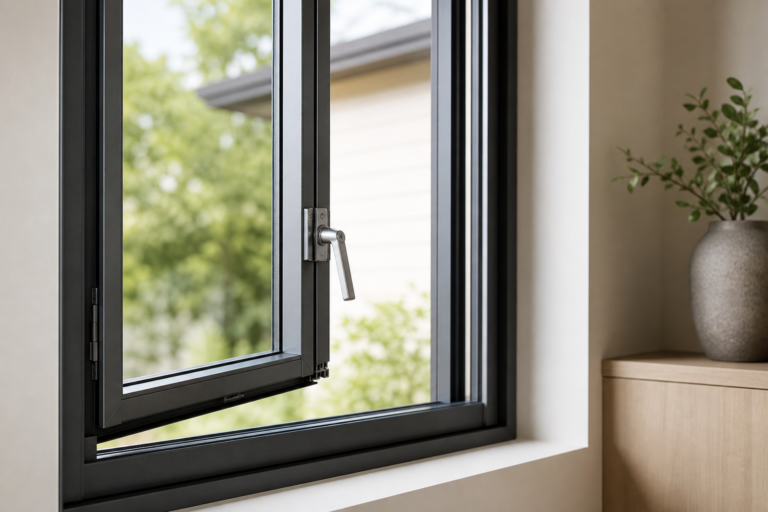
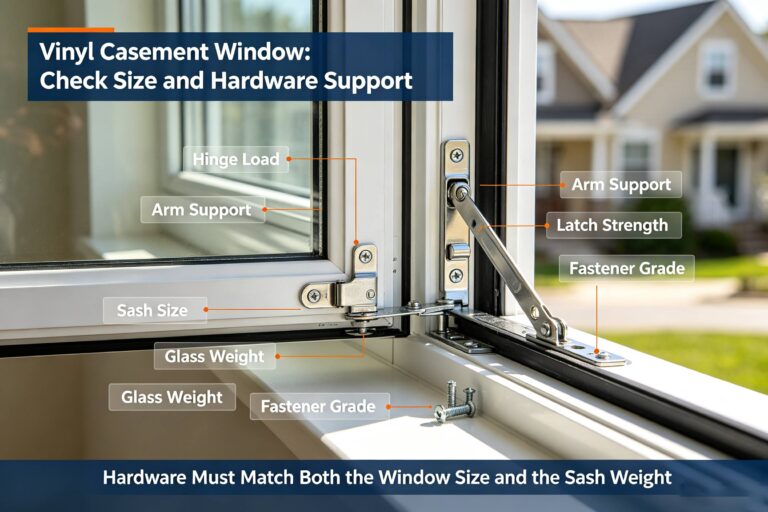
Photograph the handle in its stored and operating positions. Record whether turning, lifting, releasing, or pushing moves the sash. Note visible operator arms, tracks, stays, limiters, and covers without removing them. A control that looks similar can connect to different concealed mechanisms, so a service request needs labels and dimensions as well as the common name.
Field 2: Hinge and Handing
Declare whether every note is from inside or outside. Then identify the hinge jamb, lock jamb, and swing direction. The Forge guide to left- and right-handed casement windows explains why a consistent viewing convention matters. Add an arrow to the elevation rather than relying on “LH” or “RH” alone.
Field 3: Sash Grouping
Count moving sashes and document the center condition. Paired casements may have a fixed mullion or meeting stiles without a permanently fixed center member. If one leaf operates before the other, record the active/passive sequence. Do not use “double casement” as proof that both leaves open the same way.
Field 4: Fixed Lites
Trace frame lines around every operable sash and fixed pane. Note whether a fixed lite appears within one mulled assembly or as a separate adjacent frame. Sightline alignment does not prove shared drainage, structure, glass, ratings, or installation details. Mark uncertain frame boundaries for drawing review.
Field 5: Frame Material
Color alone is unreliable. Observe corner joints, surface finish, profile geometry, drainage openings, glazing beads, visible thermal breaks, and labels. The National Fenestration Rating Council consumer types and parts guide separates operating types from frame technologies, but a field survey still needs product-specific evidence before naming construction hidden inside the profile.
Run a Safe, Repeatable Field Survey
- Assign the opening mark. Record room, elevation, floor, photograph number, date, and surveyor.
- Photograph closed. Capture the full frame, sash grouping, fixed lites, trim, sill, screen, and nearby obstructions.
- Declare the viewing side. Write “inside view” or “outside view” on the sketch and maintain that convention.
- Operate normally. Release the lock and open only with the intended control; do not force a stiff sash or disconnect a limiter.
- Photograph the mechanism. Capture hinges, operator arms, tracks, stays, locks, labels, and attachment points.
- Measure reference geometry. Record frame, sash, visible glass, operator, fastener, and profile dimensions needed for identification—not fabrication dimensions unless the responsible party requests them.
- List unknowns. Mark material, reinforcement, glass makeup, ratings, or series as unconfirmed until evidence is supplied.
Build an Opening-Specific Identification Record
Create one row per window with the five fields, overall dimensions, photographs, sketch, label transcription, and unresolved questions. Link the row to the casement operator and lock troubleshooting guide if the purpose is service. Keep symptoms separate from identification: “will not lock” describes behavior, while “inside-view left-hinged crank casement with two locks” describes the observed unit.
For replacement work, attach wall depth, sill condition, trim, cladding, drainage, and opening measurements. For hardware work, add operator mounting, arm geometry, lock count, keeper location, hinge details, and label numbers. For design records, add fixed-lite relationships, frame sightlines, finish, glass appearance, screens, shades, guards, and intended ventilation position.
The National Fenestration Rating Council explains that its label provides standardized whole-product performance information. Use the NFRC label fields to describe what a verified record can contain, but do not transfer a label value from another size, glass package, frame, or operator arrangement.
Know What Field Identification Cannot Prove
- A photograph cannot prove concealed reinforcement, anchorage, drainage continuity, glass treatment, or certification.
- A common hardware shape cannot prove interchangeability, load capacity, handing, or finish compatibility.
- A frame color cannot prove whether the primary material is vinyl, aluminum, steel, wood, fiberglass, composite, or clad construction.
- A sash count cannot prove emergency-opening compliance, fall protection, accessibility, or safe cleaning.
- A family brochure cannot prove that ratings and options apply to the exact installed configuration.
Where the identification affects safety, code, structure, weather resistance, warranty, or fabrication, request the responsible manufacturer’s documents and qualified review. The five-field key is a communication method, not an engineering approval.
Frequently Asked Questions
What is the basic definition of a casement window?
A casement window has a sash hinged at the side that swings inward or outward. That definition describes movement only. The control, handing, sash grouping, fixed lites, frame material, glass, hardware, screen, ratings, and installation still need separate identification.
How can I tell which way a casement window is handed?
First declare the viewing side, preferably with “inside view” written on the sketch. Then record the hinge jamb and lock jamb, add an opening arrow, and photograph the sash open. Do not rely on an unexplained left-hand or right-hand abbreviation.
Is a French casement the same as a double casement?
Not necessarily. Both terms can describe paired side-hinged sashes, but a French arrangement commonly emphasizes meeting sashes without a permanently fixed center mullion. Record the center condition, active/passive sequence, locks, and opening drawing instead of treating the names as interchangeable.
Can frame material be identified from color?
No. Similar colors and finishes can appear on vinyl, aluminum, steel, fiberglass, composite, wood, and clad frames. Use labels, joint details, profile drawings, visible section features, and manufacturer records; mark the material unconfirmed when the evidence is incomplete.
Conclusion
Identify types of casement windows with five separate fields: control, handing, sash grouping, fixed-lite relationship, and frame material. A consistent inside-view sketch, photographs, dimensions, labels, and a clear unknowns list turn a vague window name into a useful record for service, replacement, or design coordination.