 2026-09-01
Direct answer: A vinyl casement window should be reviewed as a complete size-and-hardware system, not just as a PVC frame. Confirm the exact unit’s certified profile, sash dimensions and weight, reinforcement, hinge and operator fastening, glass package, performance record, finish limits, and service access before approving a large or demanding opening.
A Vinyl Casement Window Is More Than Its Frame Material
Vinyl describes a family of polymeric frame and sash materials, not one construction. Internal chambers, wall thicknesses, welded or mechanically joined corners, reinforcement, fastener inserts, glazing retention, seals, hardware, and glass can differ between systems. The U.S. Department of Energy’s building-science guide to window types notes that vinyl frames are usually made from PVC with stabilizers and that frame and glazing choices influence energy-related properties.
The material may be suitable for many casement applications, but a broad material advantage does not approve a specific width, height, sash weight, color, exposure, or hardware set. Forge Windows’ vinyl casement project checks discusses initial material fit. This article takes the next step: documenting how an operable sash is supported at the proposed size.
This is also different from repair diagnosis. If an existing unit is hard to operate, the issue could involve alignment, hardware, weather seals, frame condition, glass, installation, or a combination. The casement operator and lock troubleshooting guide helps describe symptoms. A new-unit approval instead asks whether the proposed design, hardware, and documentation form a coherent system before fabrication.

Check Dimensions, Aspect Ratio, Glass, and Sash Weight
Ask for the size chart or engineering limits for the exact product series and operator type. Record both unit size and sash size because a wide frame with a narrow operable lite may be evaluated differently from one large sash. Include the width-to-height relationship, not only area. Very narrow, very wide, or unusually tall proportions can affect glass, hardware geometry, frame behavior, and available ratings.
Glass construction changes sash weight. Pane count, glass thickness, laminated layers, decorative elements, and larger dimensions can all add mass. Do not assume that an upgraded glass package is compatible merely because it fits the glazing pocket. Ask for the allowed glass make-up, maximum sash weight, hinge set, operator, fastening details, and any reinforcement required for the quoted unit.
| Approval field | Question to ask | Evidence to retain |
|---|---|---|
| Unit and sash size | Is this width, height, area, and aspect ratio within published limits? | Size chart or written configuration approval |
| Glass package | What is the calculated sash glass weight and allowed make-up? | Glass schedule and product confirmation |
| Hinges | Which hinge type and quantity support this sash? | Hardware schedule and section/detail |
| Operator and locks | Are operator, linkage, keepers, and lock points matched to size? | Part numbers and hardware layout |
| Reinforcement | Where is reinforcement required, and how is it retained? | Profile section and reinforcement callout |
| Finish and exposure | Are color and coating approved for dimensions and climate? | Finish specification, limitations, and warranty terms |
If a requested size lies outside a standard chart, do not accept “custom” as the complete answer. Ask what changed, who approved it, which performance values apply, and whether a different division pattern would reduce risk. Two smaller operable lites or an operable-plus-fixed composition may meet the design goal more clearly than one oversized sash.
Trace the Load Path at Every Hardware Connection
A casement sash places recurring loads at hinges, operator arms, lock points, and keepers. The approval drawing should show where each component fastens and what sits behind the visible vinyl wall. Depending on the system, the connection may engage a reinforced chamber, internal metal or composite insert, purpose-designed boss, thicker wall, or other manufacturer detail. Do not invent the construction; request the actual section and fastening requirement.
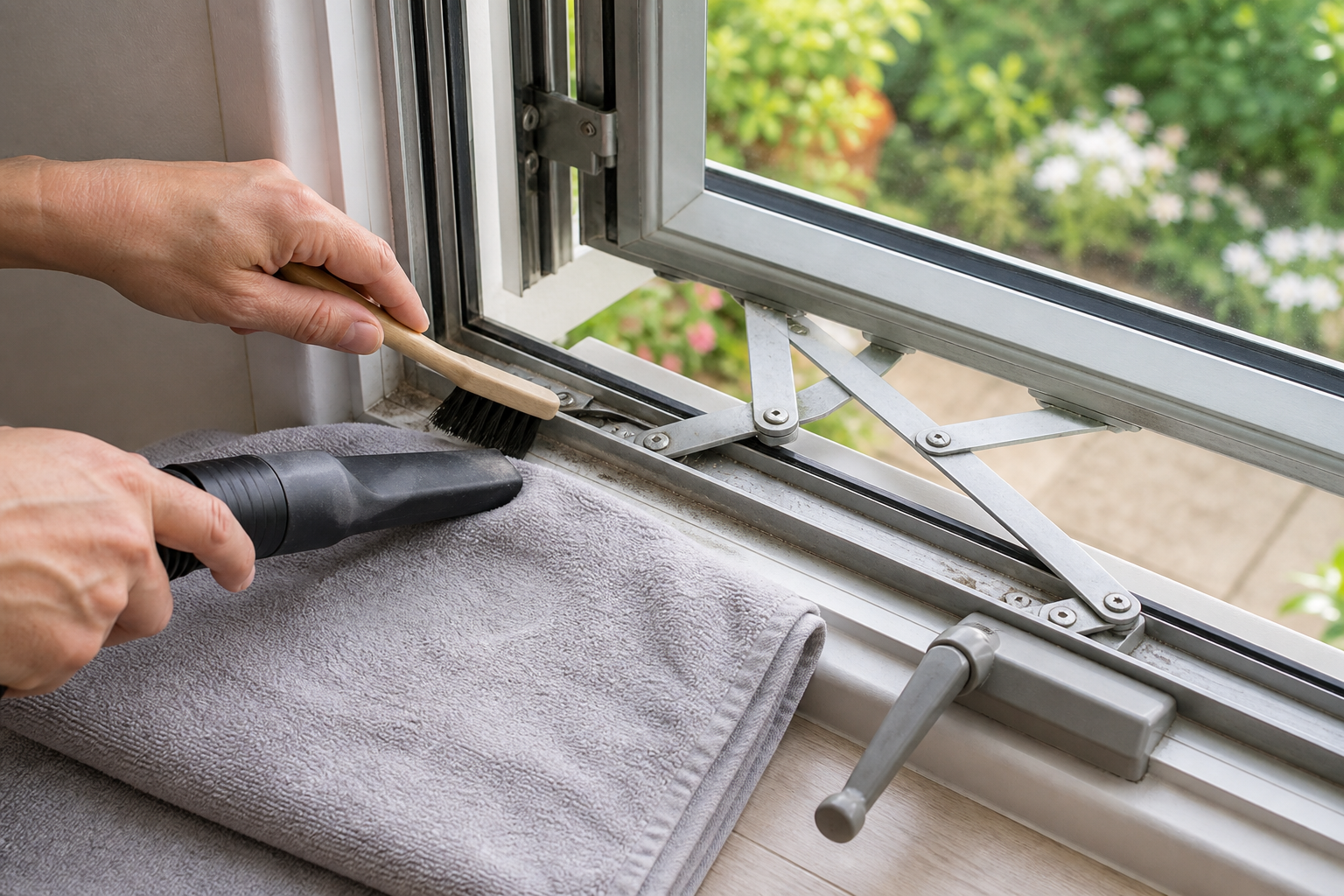
Review the hinge side from top to bottom. Identify hinge type, quantity, spacing, fastener type and length, edge distances, and the substrate engaged by each fastener. Then review the operator at the sill or jamb, including its base, track, arm geometry, travel, and service access. Finally, review locks and keepers: their number, location, fastener support, adjustment range, and how they draw the sash against the weather seals.
The AAMA 904 specification addresses durability procedures and performance criteria for multi-bar hinges used in casement and projected windows. A project team should obtain and apply the current required standards through qualified professionals; a public summary is not a substitute for the purchased standard or product-specific test evidence.
Serviceability belongs in the same review. Can the operator cover be removed without damaging finishes? Can a hinge fastener be reached? Are replacement parts identified by series and revision? Will interior trim, deep stools, counters, screens, or shades block maintenance? A durable design still needs a realistic repair path.
Review Certified Profiles and Whole-Window Performance
FGIA explains in its certified profiles overview that polymeric profiles used in products certified under its program must comply with applicable material specifications, with testing that includes properties such as impact resistance, dimensional stability, heat resistance, weight tolerance, and color retention. Ask which profile producer, compound or formulation, profile designation, certification, and production controls apply to the quoted window.
Profile certification and whole-window certification answer different questions. The profile record concerns the polymeric lineal material and its applicable requirements. The complete window record considers the assembled product. Use the NFRC Certified Products Directory for rated energy-product records, and ask the supplier to match the manufacturer, series, operator type, size, glass, spacer, and options to the submittal. Do not transfer a value from a fixed unit to a casement or from one glass package to another.
Where structural, water, air, and forced-entry requirements apply, the project documents should identify the required standards and ratings. FGIA’s NAFS overview provides useful terminology, but the responsible professional must define the project criteria and confirm the exact product designation and test or certification basis.
Finish deserves a written check, especially for dark colors or coatings. Ask whether the proposed color is integral, laminated, painted, or otherwise applied; which profiles and sizes it covers; how exterior exposure is limited; and what cleaning, heat, warranty, and repair instructions apply. Avoid broad statements about all dark vinyl products because formulations, coatings, geometry, climate, and manufacturer limits vary.
Vinyl Casement Size-and-Hardware Approval Checklist
- Record opening mark, room, orientation, exposure, unit size, sash size, handing, and opening direction.
- Identify the exact manufacturer, series, operator type, profile system, finish, and production designation.
- Confirm width, height, area, aspect ratio, glass make-up, sash weight, and finish are within documented limits.
- Request head, sill, jamb, meeting-stile, and hardware sections with reinforcement clearly called out.
- List hinge, operator, lock, keeper, limiter, and screen part numbers and fastening requirements.
- Confirm whole-window energy and project-required structural, water, air, and other performance records.
- Check projected sash travel, handle reach, screen removal, cleaning, adjustment, and part replacement access.
- Coordinate anchors, shims, sill support, flashing, drainage, perimeter joints, and interior air sealing.
- Record exclusions, substitutions, open questions, approver, revision, and resolution date.
Use the same approved fields at delivery. Forge Windows’ casement selection specifications guide can help organize the broader submittal, while this checklist keeps the vinyl sash and hardware support questions visible.
Frequently Asked Questions
Do all vinyl casement windows need metal reinforcement?
No universal answer applies. Reinforcement depends on the profile system, size, sash weight, hardware, finish, performance requirements, and manufacturer design. Request the actual sections and written requirements for the quoted configuration.
Can triple-pane glass be added to any vinyl casement?
No. The glass must fit the system and remain within allowed thickness, edge, weight, hardware, size, and performance limits. Obtain configuration-specific confirmation rather than treating pane count as a standalone upgrade.
Does a certified vinyl profile prove the complete window rating?
No. Profile certification addresses applicable profile requirements. Whole-window energy, structural, water, air, and other records concern the assembled product under their defined programs and test conditions.
What should I request for a large vinyl casement window?
Request size and sash-weight limits, glass make-up, profile and reinforcement sections, hardware schedule, fastening details, finish limitations, whole-window records, installation instructions, and service-part access.
Conclusion: Approve the System Behind the Visible Frame
A vinyl casement window is ready for approval when size, glass weight, profile, reinforcement, hardware, fastening, ratings, finish, installation, and service access all describe the same unit. Keep those answers on the opening schedule and drawing. Send Forge Windows the dimensions, glass, handing, finish, performance criteria, exposure, and hardware questions for a configuration-specific review.