 2026-08-15
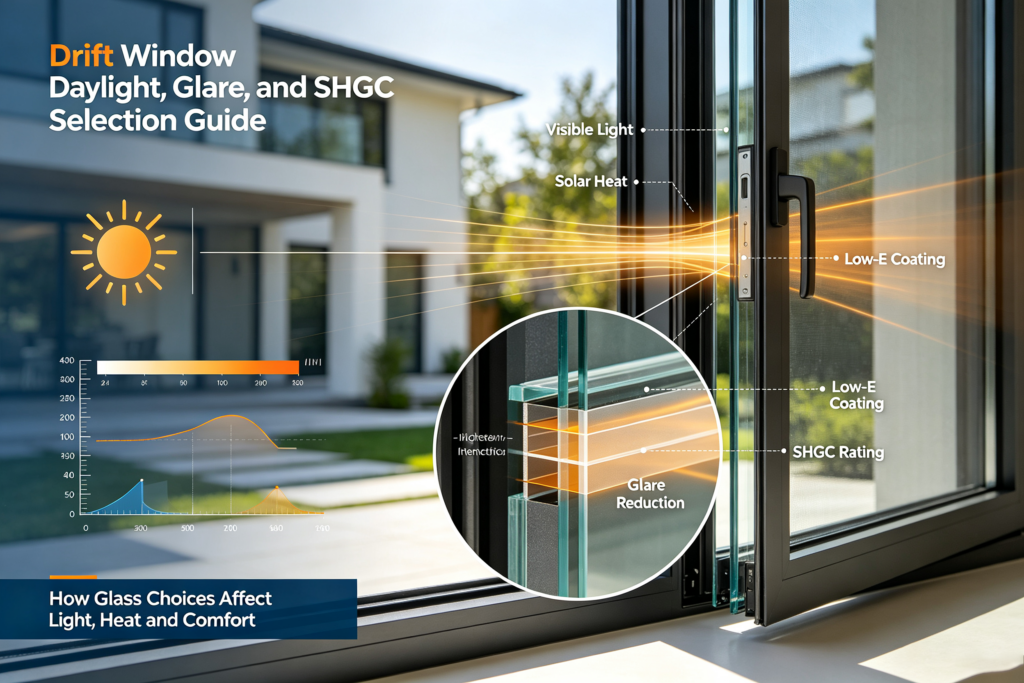
Direct answer: Drift window daylight and glare planning should balance view, visible light, solar heat gain, room orientation, shading, glass appearance, panel layout, and verified whole-window ratings. A brighter-looking pane is not automatically more energy efficient, and a darker tint does not guarantee comfort. Because “Drift window” is not a U.S. rating class, buyers should evaluate the exact Forge Windows frame, glass, tracks, panels, and installation together.
Key Takeaways
- Define the room’s daylight, view, glare, and solar-control priorities before selecting glass.
- Use whole-product visible transmittance and SHGC data for the exact configuration.
- Review orientation, exterior shading, interior shades, furnishings, and screen effects.
- Do not infer performance from tint, coating color, or product-family names.
- Approve representative samples and configuration-specific documentation.
Separate Daylight, Glare, and Solar Heat Gain
Daylight describes useful natural light in a space, while glare is visual discomfort caused by brightness relationships and reflections. Solar heat gain addresses heat entering through the fenestration under defined conditions. These concerns interact but are not interchangeable. A project should state which outcome matters at each opening.
Forge Windows presents examples such as the 128 Series Floating Sliding Window and T128 Six-Track Suspended Sliding Window. Use these pages to identify configurations for discussion. Ask for exact glass, frame, panel, screen, and rating documentation before comparing options.
Build a Room-by-Room Daylight Brief
| Input | Question | Project record |
|---|---|---|
| Orientation | Which direction does the opening face? | Site plan and room elevation |
| View priority | Which seated or standing views matter? | Interior sightline sketch |
| Glare activity | Are screens, desks, beds, or televisions nearby? | Furniture and task plan |
| Shading | What overhangs, trees, screens, or shades affect the opening? | Section and accessory schedule |
| Glass goal | What appearance and verified ratings are required? | Glass and window performance schedule |
Photograph the room at different times when possible and note the activities affected by bright light or reflections. Avoid turning those observations into unverified performance numbers. The purpose is to define user needs for the design team. Professional daylight modeling may be appropriate for complex or high-priority spaces.
Understand Visible Transmittance and SHGC
The National Fenestration Rating Council’s residential guidance (accessed August 15, 2026) explains visible transmittance and solar heat gain coefficient among whole-product ratings. Visible transmittance relates to visible light passing through the complete product, while SHGC relates to solar heat gain. Neither metric alone determines comfort in every room.
Compare the exact Drift window configuration, including frame, glass, panel count, operator type, and qualifying size. A center-of-glass value is not the same as a whole-window rating. Do not compare one proposal’s whole-product value with another proposal’s glass-only value. Ask suppliers to label the basis of every number.
Account for Tracks, Frames, Screens, and Panel Overlap
Multi-track systems can create different frame areas and overlapping panel zones across the elevation. Screens, handles, interlocks, and parked panels can also affect the view and visible opening. Draw the window in closed and open positions. Evaluate the actual configuration rather than a simplified glass rectangle.
The Forge Windows Drift window track and panel guide provides a layout framework. Coordinate that diagram with the glass schedule and room sightlines. If multiple glass types appear in one elevation, confirm visual consistency expectations and identification. Avoid substitutions that change appearance or ratings without approval.
Coordinate Exterior and Interior Shading
Overhangs, fins, nearby buildings, trees, screens, blinds, and shades can alter light and glare at different times. Show fixed shading on elevations and sections, and show movable shades in the interior schedule. Confirm that hardware and shade tracks do not conflict with window handles, locks, screens, or service access. Accessories should not block drainage or require unapproved frame drilling.
A shade may improve user control without changing the window’s certified rating. Keep product ratings and separate accessory claims distinct unless verified documentation connects them. Ask for samples of glass and shade materials together. Review them under conditions that resemble the finished room when feasible.
Verify Current Product Documentation
Use the NFRC Certified Products Directory (accessed August 15, 2026) when researching listed configurations. Match manufacturer, series, operator, size qualifications, frame, and glass carefully. Save the applicable record with approved submittals. Do not claim certification based on a similar product.
ENERGY STAR publishes current residential window, door, and skylight criteria (accessed August 15, 2026). If ENERGY STAR qualification is required, confirm the exact certified configuration and current climate-zone criteria. Do not infer qualification from tint, coating, or thermal-break terminology.
Daylight and Glare Approval Checklist
- Room orientation, activities, furniture, and priority views are documented.
- Glare-sensitive tasks and times are identified.
- Track, panel, screen, handle, and overlap zones are drawn.
- Whole-product visible transmittance and SHGC are clearly labeled.
- Glass appearance and representative samples are reviewed.
- Exterior and interior shading are coordinated with operation and service.
- Certification claims match the exact proposed configuration.
Send room photographs, orientation, window dimensions, panel layout, glass goals, and required documentation through the Forge Windows contact page. Ask which current options meet the technical brief. Keep the approved glass and rating records with the final order.
Frequently Asked Questions
Does higher visible transmittance always mean a better window?
No. The appropriate value depends on daylight goals, glare, orientation, shading, room use, appearance, and other performance requirements.
Is lower SHGC always better?
No universal value fits every climate and project. The design team should consider orientation, climate, shading, heating and cooling goals, and current criteria.
Does darker glass guarantee less glare?
Do not assume so. Glare depends on brightness relationships, reflections, room layout, sky conditions, shading, and the exact glass characteristics.
Do screens affect the view?
Screens can change visible appearance and sightlines depending on mesh, frame, lighting, and viewing distance. Review a representative sample and complete elevation.
Where should performance values come from?
Use current manufacturer documentation and authoritative directories matched to the exact whole-product configuration, not a generic glass description.
Conclusion: Match the Drift window to the Room
Drift window daylight and glare selection should connect room use, orientation, view, shading, glass appearance, tracks, panels, and verified ratings. Avoid choosing by tint or one isolated metric. Forge Windows can review current configurations when the project team supplies a clear brief. Approve the exact glass-and-window package before fabrication.