2026-09-12
Interior folding doors are useful when connected panels can park beside an opening without obstructing the room. Choose them by the job they must do: conceal a closet, divide living areas or manage occasional access. Check clear passage, panel projection and privacy before selecting the finish.
Decide what the room needs first
A closet door and a room divider may fold in a similar way but need different everyday checks. A closet must expose shelves and drawers. A divider needs to work with furniture and circulation on both sides. Write down the main use before comparing panel materials.
JELD-WEN identifies bifolds as an option for storage and utility areas. That is a useful starting point, but the opening’s actual layout still matters. A door can fit its frame while making a drawer behind it difficult to use.
Interior folding doors: compare three room layouts
| Location | Test before ordering | Detail to record |
|---|---|---|
| Wardrobe or pantry | Open the largest drawer beside the proposed panel stack | Clear access width and handle position |
| Study beside living room | Check both the open furniture layout and closed privacy | Opaque or glazed infill, seals and documented sound performance |
| Utility area | Check service access and the appliance instructions | Required opening and any ventilation provisions |
Measure the space the moving panels need
Use tape on the floor to mark the proposed projection and parking area from the supplier’s drawing. Try the room with chairs pulled out and nearby cupboards open. Include the handle, not only the panel edge. Do not assume that folding means zero swing clearance.
Measure width at several heights and height at several positions, then let the installer determine the appropriate order dimensions. Describe the planned finished floor. A later change from thin flooring to thick carpet can affect operating clearance. Model-specific instructions take priority over a generic allowance.
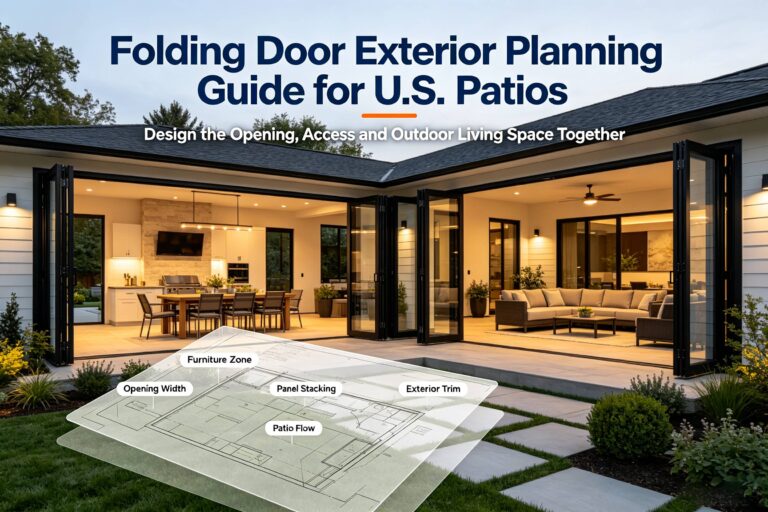
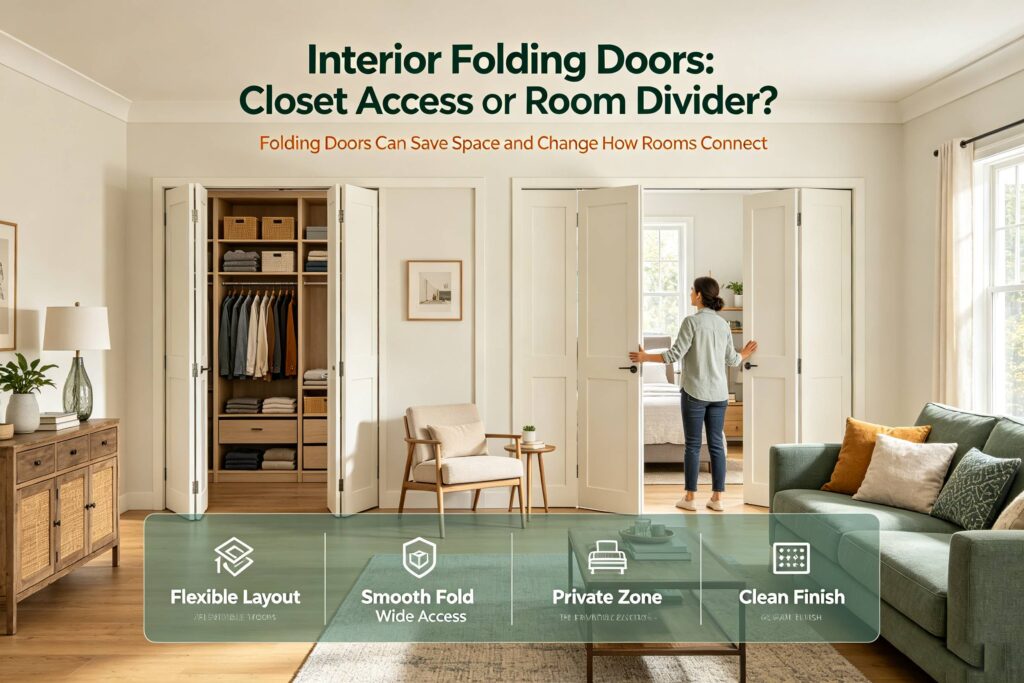
For a glazed interior system, the site photograph above helps illustrate how articulated panels occupy space in front of the opening. It does not establish the pictured product’s sound rating or suitability for your room.
Separate visual privacy from acoustic privacy
Frosted or textured glazing can change the view through a partition, but it does not establish acoustic isolation. If confidential calls or sleep are the priority, request documented performance for the complete assembly and discuss gaps and perimeter details. Avoid comparing doors using a panel-only claim.
Similarly, an ordinary interior door should not be assumed to provide a required fire separation. Where a specific performance is required, ask the designer to identify an appropriate documented assembly. Do not modify an existing rated opening based only on a style preference.
Frequently asked questions
Are folding doors better than pocket doors?
They solve different layout problems. Folding panels need a parking area at the opening. A pocket system needs suitable space inside the wall. Compare the actual installation and room constraints.
Can interior folding doors be glazed?
Yes, glazed interior folding systems exist. Confirm the selected glass and assembly are appropriate for the location, and decide how much visual privacy is needed.
Can I use the closet measurement to order immediately?
Use preliminary measurements for discussion, then obtain the selected system’s measurement requirements and a final installation survey before ordering.
For interior folding doors, a good brief describes what must remain accessible when the door is open and what must be separated when it is closed. Review the stacking layout guide and hardware planning guide with those two conditions in mind.